Center for Theoretical Physics
A division of the Department of Physics and the Laboratory for Nuclear Science.
Important links

Our Research
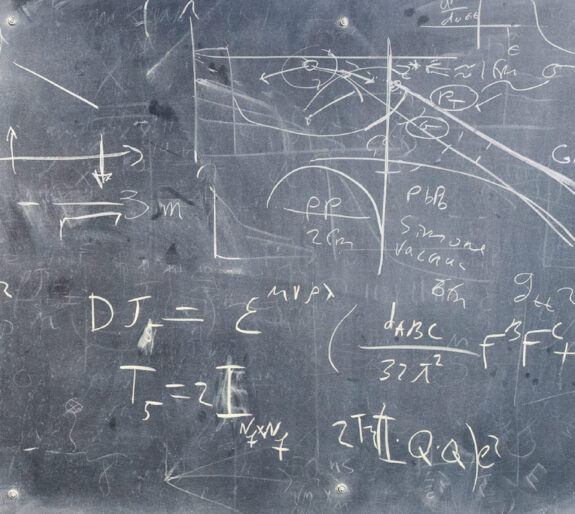
We are a unified research and teaching center focused on fundamental physics. Our activities range from string theory and cosmology at the highest energies down through unification and beyond-the-standard-model physics, through the standard model, to QCD, hadrons, quark matter, and nuclei at the low energy scale.
Recent Publications
-
Constraints on the finite volume two-nucleon spectrum at \(m_\pi \approx 806\) MeV
William Detmold, Marc Illa, William I. Jay, Assumpta Parreño, Robert J. Perry et. al.
April 18, 2024, arXiv:2404.12039Abstract: (click to show) -
Practical applications of machine-learned flows on gauge fields
Ryan Abbott, Michael S. Albergo, Denis Boyda, Daniel C. Hackett, Gurtej Kanwar et. al.
April 17, 2024, arXiv:2404.11674Abstract: (click to show) -
Multiscale Normalizing Flows for Gauge Theories
Ryan Abbott, Michael S. Albergo, Denis Boyda, Daniel C. Hackett, Gurtej Kanwar et. al.
April 16, 2024, arXiv:2404.10819Abstract: (click to show) -
Wormholes and Factorization in Exact Effective Theory
Sergio Hernández-Cuenca
April 15, 2024, arXiv:2404.10035Abstract: (click to show)